The Language You Speak Is Part of Who You Are
21 May 2026
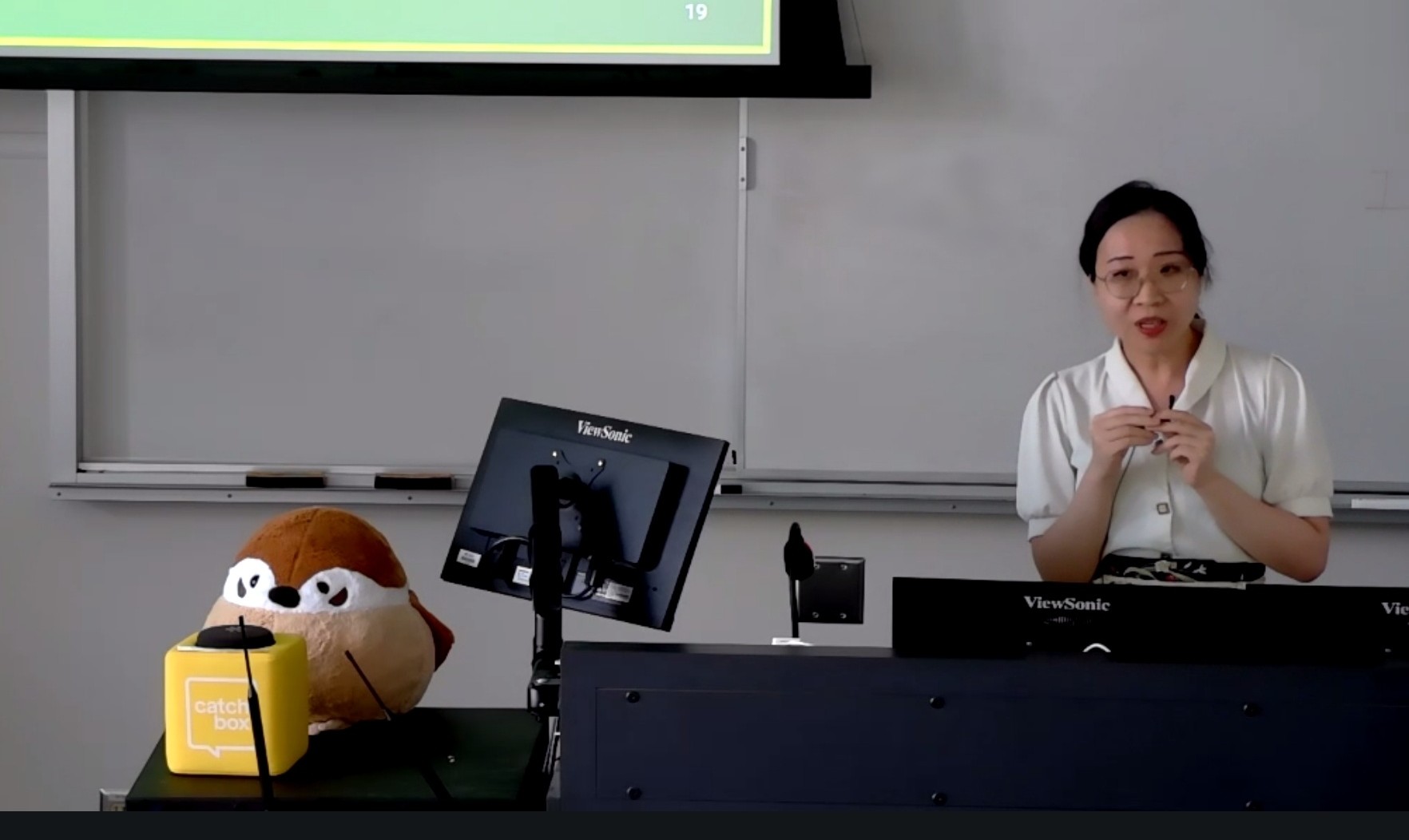
In junior high school in Harbin, China, Youran Lin read a story about a French teacher and his students living under Prussian occupation — stripped of their right to learn their own language. She was moved in a way she couldn't quite explain.
That moment sparked something. A fascination with French. Then Russian, after she became a fan of a Latvia-born Ukrainian and Russian singer in high school (shout-out to Vitas!). Then a deeper pull toward understanding how languages work, how they're learned, how they shape the people who speak them. She went on to study linguistics in Beijing for seven years — but it wasn't until a labmate came back from the Netherlands and mentioned something called "speech-language pathology" that everything clicked into place.
"I didn't know about SLP until the first year of my master's," she says. "But once I did, I saw how linguistics could translate into direct help for people."
That realization brought her to the University of Alberta — first as an exchange student, then as a researcher, and now as an Assistant Professor in the Faculty of Rehabilitation Medicine. Edmonton and Harbin, she notes with a smile, are twin cities.
Today, Lin's research focuses on multilingual individuals and families — particularly those navigating the tension between their home language and English. She works with children in Mandarin-English bilingual programs, children from bilingual families diagnosed with communication disorders, and newcomer families who arrived in Canada under circumstances that left little room for anything but survival.
"Some of my works analyzed language data from Syrian refugee children, who were very different from the bilingual children we usually encounter in research studies,”The Syrian refugee children I've worked with — their motivation to learn English was safety, desperation, survival," she says. "The level of stress and mental wellbeing is really a huge factor in language development. And maintaining a strong identity with their Syrian culture, instead of being pressured to fully adopt the Canadian culture, was related to better bilingual outcomes."
One of the most persistent misconceptions she encounters? That English should come first — and that everything else can wait. Parents are often told, directly or indirectly, that prioritizing the home language will slow their child down.

"All the resources, all the therapies — they're in English," Lin says. "So parents end up doing the heavy lifting for the home language on their own or even decide to give up on their home language because there is just too much to handle. But the home language is just as important. And you only realize what's lost once it's gone. It's hard to get it back."
Her own path to understanding this wasn't only academic. As the only international student in her clinical cohort, Lin spent years learning to navigate spaces that weren't built with her in mind — the pace of group conversations, the unspoken rules about when to speak and when to hold back, the subtle pressure to fit in rather than stand out.
"I felt like I needed to completely revise how I talked and who I was," she says. "But gradually I tried to let the Chinese me and English me mingle. And you know what, I quite like that girl. She ended up not changing too much."
That experience now informs how she teaches. In a course she teaches with Lecturer Laura Brompton, SLP students are asked to study a language they don't speak, learn its speech sounds, and design clinical tools for speakers of that language. It's a small ask with a large point: you don't have to be fluent to be curious. You don't have to share someone's language to take it seriously.
"Students loved it," she says.
When asked what success looks like, Lin doesn't reach for metrics. "I hope people think of me and think, 'She taught me something.'"
A student from a minority background once told her: "I feel really comfortable seeing you are in the program teaching us."
For Youran Lin, that's the work.
Youran Lin is an Assistant Professor in the Department of Communication Sciences & Disorders at the University of Alberta's Faculty of Rehabilitation Medicine. Her research focuses on multilingual speech-language development across lifespan.