Yang Zhoug '25 MFM
Roveena Mecwan, BAA Committee Volunteer - 14 September 2026
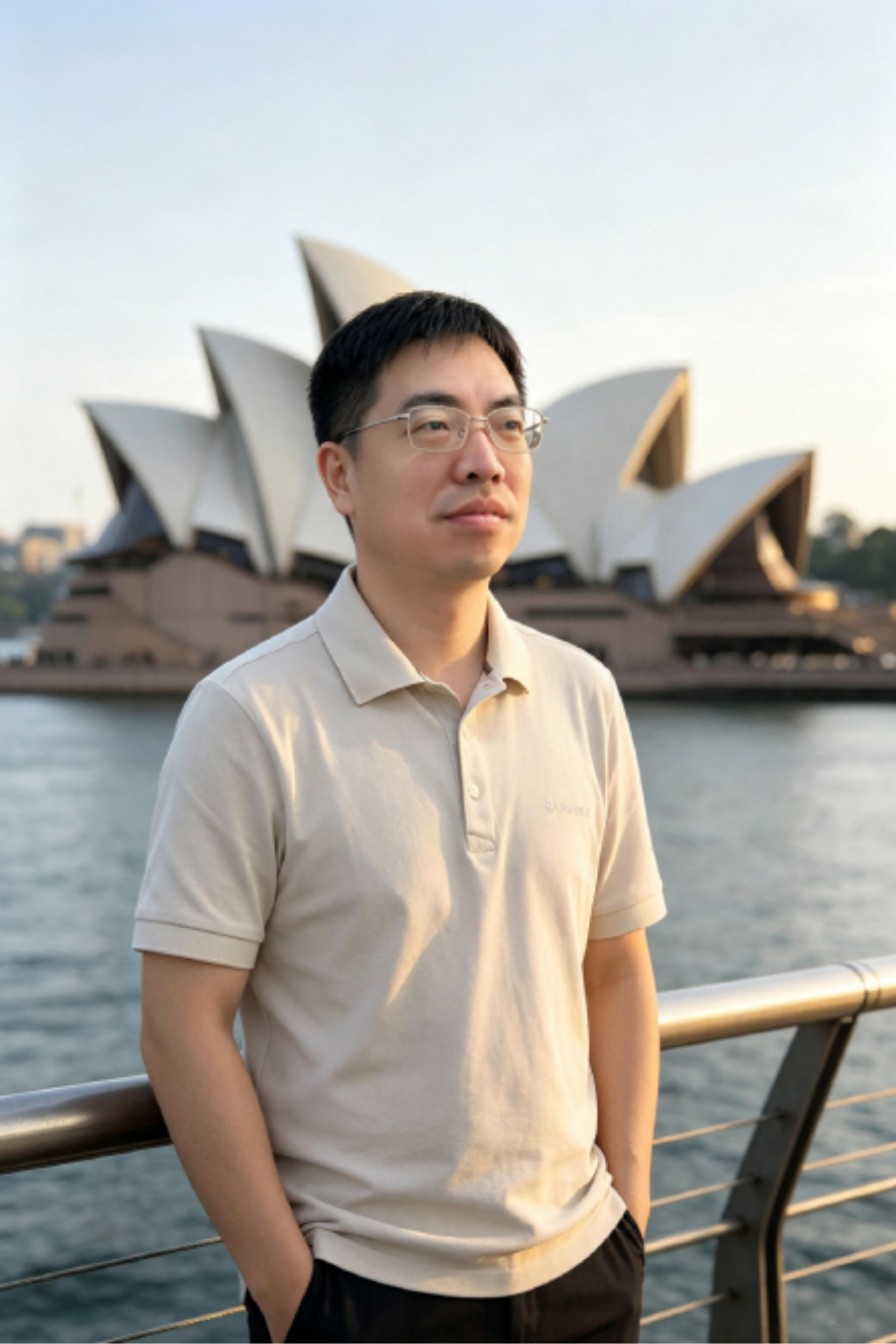
As a student of the ‘25 Master of Financial Management (MFM) program in Shanghai and Chief Financial Officer of Kuangshi Aromatic Holdings Ltd., Yang Zhou brings a distinctive portfolio to the program: ten years of supply chain management experience at a listed retail chain group, eight years of private equity investment management, and six years of transnational corporate financial management practice. In this interview, he shares how the Master of Financial Management curriculum has provided a systematic theoretical framework for his twenty years of hands-on experience — and how he has been applying it in real business contexts: global tariff shocks, cross-border financing restructuring, and strategic asset allocation.
Professional Convergence: Building a Unified Framework Across Industry and Finance
Yang Zhou's career trajectory is not defined by deep specialization in a single domain, but rather by repeated crossings between industry and finance. For the first decade of his career, he managed supply chain and procurement at a major domestic supermarket chain, accompanying the company through its IPO journey. During the 2008 global financial crisis, he handled commodity procurement directly tied to international futures prices — only to realize afterward that he had been unconsciously applying financial principles all along, simply lacking a formal theoretical framework to name them.
"During the subprime crisis, commodity prices plummeted. Yet we kept turning a profit. When I reflected on it later — I realized I had been applying financial laws intuitively. I just couldn't articulate what those laws were called."
This reflection prompted his first crossing: departing the retail industry during the period when China had just opened private equity fund manager registrations, he founded a private equity firm. Over the following eight years, he accumulated systematic experience across primary market investments, secondary market trading, and portfolio risk management.
"The rules of finance and industry are worlds apart," he recalls. "It took years of trial and error before I slowly found the path to combine the two."
Drawing on this phase of accumulation, Yang Zhou developed what he describes as a "cross-boundary integration profit model" — industry teams retain industry profits, finance teams retain finance profits, while the profits from cross-boundary integration alone yield substantial returns. This model continues to underpin the financial architecture of multiple listed entities under his stewardship.
In 2022, he completed his second crossing: returning to industry development as CFO of a company whose core products are sold in over twenty countries, with customers primarily concentrated in European and North American markets. As CFO, Yang Zhou oversees the company's global financing, cross-border investment, and M&A strategy. It was during this phase — as the cross-border management demands of the company's newly acquired Southeast Asian manufacturing facility grew increasingly complex — that Yang Zhou encountered the Master of Financial Management program.
"When I saw the name 'Financial Management' and read through its curriculum, something clicked. This was exactly the theoretical knowledge I needed. The professors in the program don't just teach theory — they all have practical experience in their respective fields. That tight integration of theory and practice is precisely what I had been searching for."
Applied Capability: Translating MFM Courses into Strategic Decisions
Unlike most learners who pursue knowledge "for future reserves," Yang Zhou enrolled in the Shanghai cohort of the MFM program in 2025 facing an urgent and real-time agenda: he needed to restructure the company's global financing pathways, reassess investment returns, and evaluate market entry strategies.
Yang Zhou notes that the curriculum taught him not only to view a country's purchasing power through the lens of exchange rates, but ultimately to derive asset allocation decisions from that analysis. This framework directly helped him assess global capital flows and plan multi-currency financing strategies. When he began benchmarking the company's financing costs across multiple jurisdictions, the model immediately demonstrated its operational-level value.
"In China, companies with our credit rating can secure financing at an annualized rate of just over one percent. But in Southeast Asia, the minimum is at least 7.5. That gap of five to six percentage points — before any operational decision is made — is already a structural competitive advantage."
Yang Zhou emphasizes that the value of the MFM program goes far beyond any single model or formula. Its core lies in providing a systematic analytical language for the judgments he had made over the past twenty years purely on intuition.
"Finance is not simple arithmetic. It encompasses understanding business models, capital structures, investment returns, and asset allocation. The MFM program gave me the vocabulary to articulate my intuition — and the precision instruments to act with accuracy."
Cognitive Evolution: From Intuitive Judgment to Systematic Financial Thinking
Yang Zhou describes his decision-making mode before entering MFM as "unconsciously effective." "I could deliver results, but I couldn't explain why. I couldn't hand the methodology to my colleagues, nor could I replicate it in new markets."
The shift toward systematic thinking was accelerated by the peer-learning environment within MFM. Yang Zhou describes his Shanghai cohort — professionals from manufacturing, logistics, technology, financial services, and other industries — as a critical dimension of the program's value. Classroom discussions frequently extended into post-session exchanges, producing operationally actionable insights.
During one after-class discussion, a peer working in cross-border logistics mentioned that Southeast Asian warehousing costs were far lower than Yang Zhou had previously estimated. This information directly prompted him to reassess the supply chain model for the company's Southeast Asian facility: shifting some raw materials previously exported from China to local Southeast Asian procurement, further mitigating tariff risks while reducing logistics costs.
The cross-industry composition of the Shanghai cohort — with an average age of 38 and approximately 60% comprising business founders, senior executives, or C-level managers — created what Yang Zhou calls "an atmosphere where everyone interprets theory through the lens of their own industry reality."
The professors in the Shanghai cohort are rigorous and exceptionally dedicated — meticulously refining content for every session and patiently addressing each student's questions after class. His classmates were equally impressive: executives and founders from diverse industries, each bringing solid practical experience into the classroom. The insights generated in discussions frequently extended beyond the curriculum itself.
Yang Zhou acknowledged that the Shanghai cohort's strong learning atmosphere and his classmates' enterprising spirit were among his most cherished takeaways from these two years. Beyond the professors and classmates, Yang Zhou was equally impressed by the Shanghai cohort's class advisor and student service team — from enrollment guidance to course scheduling, from daily communication to event organization, every staff member was meticulous and attentive, enabling working professionals to focus fully on their studies.
"Each of us walked into the classroom carrying a different industry background. When we discuss the same framework — a valuation model, a risk-pricing methodology — everyone reads it through the reality of their own enterprise. That collision of perspectives is where the deepest learning happens."
Alumni Engagement: Bridging the Program and Industry
Yang Zhou participated in an offline alumni sharing event organized by the MFM program and joined a roundtable discussion with Edy Wong, Associate Dean of the University of Alberta School of Business. The event brought together current students, alumni, and faculty, giving Yang Zhou an opportunity to share how he applies MFM frameworks in cross-border corporate financial practice.
During the roundtable, drawing on his practical experience serving leading export-oriented enterprises, Yang Zhou addressed common industry pain points — "high tariffs, constrained supply chains, cross-border capital flows" — and presented a systematic approach to overseas expansion, offering fellow students fresh perspectives for breaking through these challenges.
Looking ahead, Yang Zhou believes that overseas expansion is not a "one-size-fits-all" model; it must be flexibly designed according to industry characteristics, enterprise scale, and target markets. At the same time, through "resource integration, policy adaptation, and model innovation," the pressures of trade friction can be transformed into catalysts for competitiveness — for instance, shifting from "passively responding to tariffs" to "proactively planning supply chain and tax architectures," and from "individual enterprise expansion" to "industry chain collaborative cost reduction." He provided actionable directions for different types of enterprises pursuing overseas expansion.
"The future belongs to cross-boundary talent. In my own understanding, finance represents a higher-order domain — it requires insight into business models, comprehension of capital logic, judgment of investment returns, and mastery of asset allocation. Learning is boundless. I encourage everyone with aspirations in this field to join this program and grow together."
Subscribe to UAlberta Business
Become part of our community. Get the latest news and event information from the Alberta School of Business in your inbox every month.