Alexander Batchvarov, '92 MBA
Roveena Mecwan, BAA Committee Volunteer - 17 February 2026
Alexander Batchvarov, ‘92 MBA, is the managing director of International Structured Finance Research at Bank of America in London, where he oversees markets across Europe, the Middle East, and Africa (EMEA), Asia-Pacific (APAC) and Latin America. He came to the Alberta School of Business from Bulgaria in the early 1990s, shortly after the fall of the Berlin Wall, hopeful to carve out a future in finance. His MBA became the springboard into a world of opportunity, and three decades later his achievements stand as proof of that leap. Looking back, Batchvarov describes his career as one shaped as much by chance as by perseverance — barely linear and deeply serendipitous. It is rather ironic that his path to “structured” finance was anything but structured — guided instead more by serendipity.
BAA: You’ve had a distinguished career in finance. What drew you to focus on structured finance and securitization and why Europe and emerging markets?
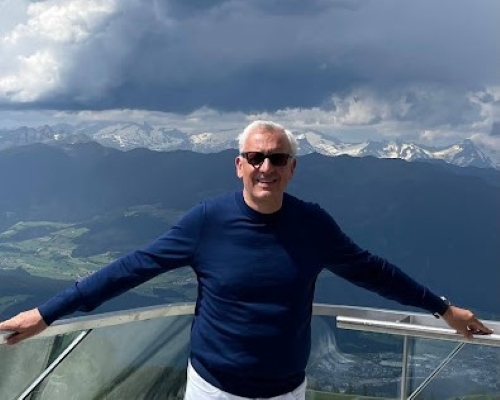 I wish I could say I had a clear vision and a plan to work in structured finance research when graduating from the U of A. The reality was much more complex than that and the path to what became my professional career, far from a straight line. After stints in academia, commercial real estate, foreign trade and international joint ventures, I joined serendipitously the Citibank associate training programme in NYC. As part of my rotation, away from transaction banking, I spent some time in the Citibank emerging markets securitisation group and the first transaction I got exposed to there was the innovative securitisation of Varig ticket sales receivables on Brazil – Japan routes.
Later, I joined Moody’s to initially rate US consumer credit securitisations, and subsequently re-focusing on securitisations outside US: in Europe and in emerging markets. The latter two became the focus of my work at Merrill Lynch back in 1998 and subsequently at Bank of America from a base in London, UK with stints in APAC and Latin America.
BAA: You’ve worked across different markets and financial cycles. Which period tested your expertise the most?
The tests always come during periods of stress, especially systemic stress, and in my experiences we had a major such stress in each of the four decades that I have been following the market: the Asian financial crisis at the end of 1990s, the Global Financial Crisis in second half of 2000s, the Eurozone crisis in early 2010s and the Covid pandemic in early 2020s. There are several (to simplify) interconnected problems that a securitisation market participant must solve for: degree of current and expected credit risk, degree of current and expected price risk and the interconnectedness between the two.
The challenge in the international securitisation market on many occasions was — and continues to be — the disconnect between credit risk and price: that was the case on the Hong Kong MBS markets in the late 1990s, on the European and Australian MBS and ABS markets during the Global Financial Crisis, and on the EUR CLO markets during the pandemic, to mention a few examples. As a Structured Finance market strategist, I had to, and still do regularly, defend my views derived from European and APAC market data and qualitative analysis against generalised views and media statements calibrated on other markets. But this is the innate human problem of cognitive dissonance and of a disconnect between facts and make-believe, isn’t it?
BAA: Thinking back to your MBA days in the 1990s, how would you characterize that time, and what experiences remain most vivid for you?
I have to put my MBA days into a specific context: I came to do an MBA in Canada right after the fall of the Berlin Wall, because my MSc and PhD in international economics degrees from Bulgaria were not recognised to allow me to seek a professional career in international finance and economics, which I had always desired. For me, some courses were a repetition of what I had already studied, like macroeconomics, while others were new to me, like accrual accounting. This allowed me to acquire knowledge in new areas and expand knowledge in some areas of my choice: international economics and finance with professor Mirus and international joint ventures with professor McFadyen.
Away from the business school, my most vivid memories and formative experiences come from my interaction with the Mactaggart family. In fact, Sandy and Alastair Mactaggart were the reason that I came to Canada: serendipity in life plays on all levels. Without their support I would not have come to the U of A, and I would not have had the opportunity and the impetus to attain the worldviews that I hold today and to influence — positively, I hope — the professional and personal lives of other people, consciously or unintentionally.
BAA: In your role leading international structured finance research, how do you identify emerging opportunities before they reach the mainstream market? What is the current best strategy for global investors?
On the financial markets, emerging opportunities almost always reveal themselves through the so-called ‘esoteric’ products. Securitisation was esoteric in the US in the late 1980s and gave rise to a several-trillion-dollar market by the mid-2000s; the Varig ticket receivables transaction that I mentioned above was ‘esoteric’ in 1993 and gave rise to billions of future flow securitisations by late 1990s and through to the Global Financial Crisis. These ‘esoteric’ transactions came to solve a problem that many market participants had in spades and needed solved in scale: financing, capital, credit rating, liquidity, etc..
By the same token, just a couple of years ago asset-based finance, direct lending and synthetic securitisations were all considered ‘esoteric’ in the West; today they are growing and expanding into APAC and Africa. EV and solar panel financings are moving geographically the opposite way. There is a fundamental need for all of them; they solve existing and growing problems with ease and at scale. That is the key. By contrast, music royalties securitisation was esoteric back in 2005, and remains esoteric today.
At present, the world, in general, and the financial markets, in particular, are undergoing a radical transformation due to geopolitical, climate and technological changes, all accelerating simultaneously and magnifying each other. The pieces of the world puzzle are re-arranging themselves under these forces and I doubt anybody fully knows where they will fall and what new picture they will create. Under these circumstances, increasing diversification — not putting all your new eggs in one or two old baskets — on the financial markets may be the best strategy to avoid under- and over-estimation of any one market.
BAA: If you could invite two people — living or past — for dinner, who would they be and what would be the topic of discussion?Are there any books, hobbies, or interests outside of work that you particularly enjoy?
I was asked the same question for a feature by FT Live readied for the Global ABS Conference in Barcelona last June. Then, I gave the answer Confucius, and now I also add Gandhi. I would like to ask them about self-reliance and cooperation, about preparing for the unexpected, about innovation and tradition, about achieving political and social progress without wars, and about mutual toleration in a divisive world.
I enjoy diversity both at work and outside work, but that comes at a price: breadth over depth. At work it is the geographical and product coverage: it is rather wide. Outside work, it is literature, art, science, architecture. I dabble in contemporary Anglo-Saxon photography as much as I learn about Chinese Neolithic and Han dynasty pottery. I enjoy reading Georgi Gospodinov and Fyodor Dostoevsky as much as Carlo Rovelli and Richard Feynman, but I am the first to admit that there is a lot in there that I do not fully comprehend. I love travelling and I am two thirds of the way to visiting all the UN member states, but I doubt that I can reach this target under the current geopolitical environment.
Subscribe to UAlberta Business
Become part of our community. Get the latest news and event information from the Alberta School of Business in your inbox every month.