3MT award winners at the 2025 Business PhD Research Conference
What can brands learn from saying less? Why might one gift be better than many? And how can institutional preservation become a form of disruption?
In just three minutes and one slide, the 2025 3MT Award winners from the 2025 Business PhD Research Conference, which took place on November 28, tackled big questions in front of a multidisciplinary audience with clarity, confidence and impact. Congratulations to this year’s top presenters:
1st place — Roghi Teimourfamian Asl (Marketing)
Too Much Talk? The Status Effect of Brand Reply Frequency on Social Media This research by Roghi Teimourfamian Asl examines the frequency with which brands respond to customer comments on the brand’s social media posts, showing that reply frequency shapes consumer perceptions. Two surveys reveal the practical relevance of studying response frequency: social media managers reported lacking formal guidelines and showed high default responsiveness, while consumers reported noticing and forming impressions based on how often brands reply.
Yet two experiments show that brands who respond to fewer comments are perceived as having higher status, which improves brand attitudes and influences downstream outcomes. These findings challenge the common assumption that a higher reply rate is always beneficial, suggesting that, in promotional contexts, responding less can signal prestige and enhance consumer evaluations.
2nd place — Bijit Ghosh (Marketing)
The Gift Gradient: Unveiling Emotional Trajectories and Backfire Risks in Multi-Gift Scenarios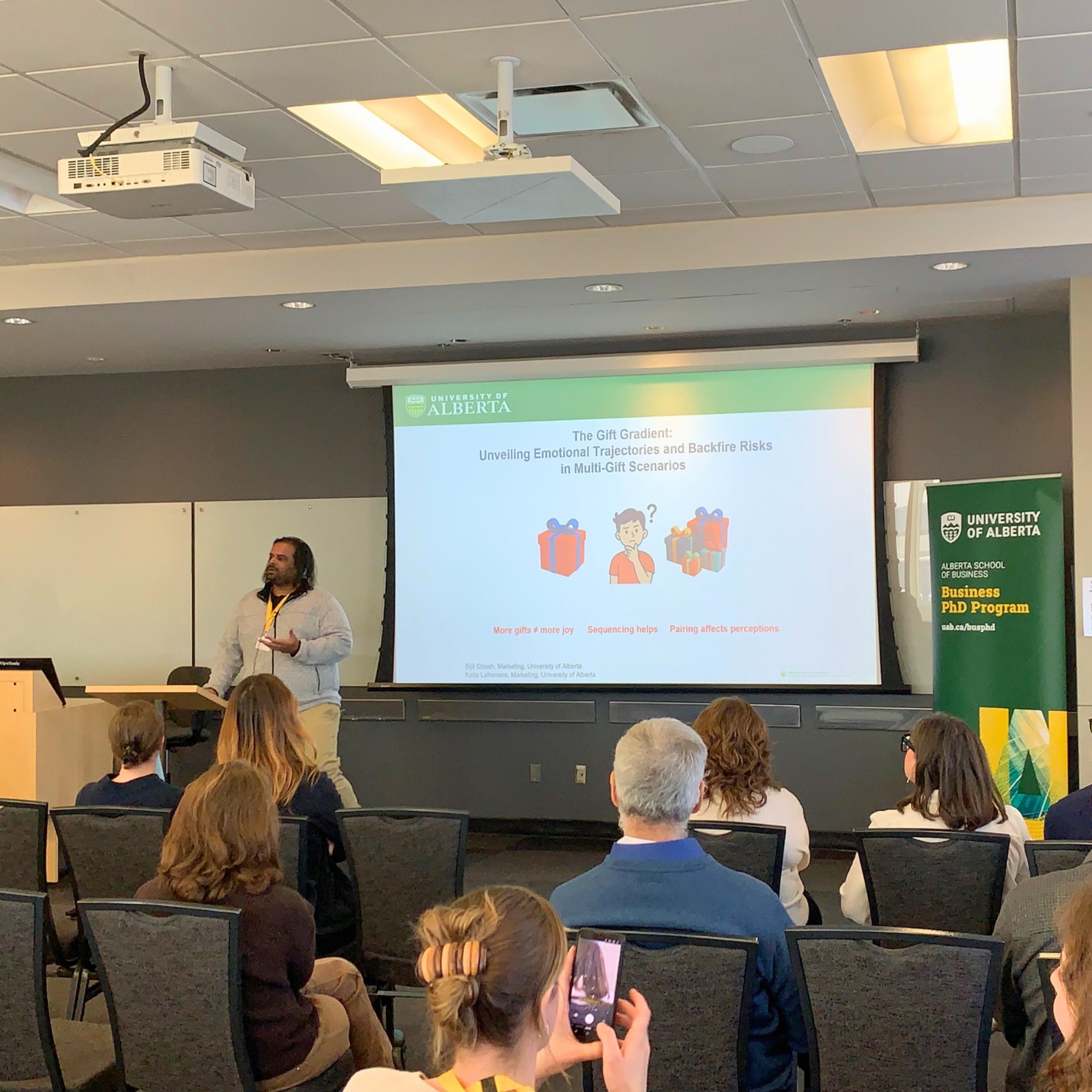 Both gift givers and receivers intuitively believe that “more is better.” Receivers, in particular, claim to love the unwrapping experience and expect multiple gifts to be more enjoyable than one. Yet this belief is misguided, says Bijit Ghosh. Across multiple studies, we show that receivers’ enjoyment collapses once the unwrapping begins.
Before unwrapping, receivers imagine the perfect gift, which makes the real gift feel disappointing. As a result, each additional gift introduces another opportunity for that expectation to be unmet, producing multiple disappointments rather than cumulative joy.
Therefore, receivers report more positive affect and attitudes toward a single gift than toward multiple gifts, even when the total value of the multiple gifts is much higher than the single gift.
3rd place - Julian Faid (SEM)
Institutional Maintenance as Disruption: Evidence from the Alberta Separatist Movement Institutional maintenance work is typically understood to reflect actors' commitment to preserving existing institutional arrangements. This study examines a paradoxical form of institutional work in which actors engage in maintenance practices with the explicit intent of disrupting the institutional order.
Drawing on a study of the Alberta independence movement, Julian Faid explores how separatists must work within existing institutional rules to establish the credibility necessary to challenge those institutions. This work suggests institutional maintenance may be strategic rather than normative, in which actors preserve the form and procedures of institutions while rejecting their underlying authority and working toward dismantling those institutional arrangements. This study contributes to the theory of institutional work by examining how maintenance work can be temporally bounded, strategically motivated, and compatible with fundamental institutional disruption, complicating our understanding of what constitutes institutional maintenance.
Learn more about the PhD Program at the Alberta School of Business here.
Subscribe to UAlberta Business
Become part of our community. Get the latest news and event information from the Alberta School of Business in your inbox every month.