How information asymmetry shapes market behaviour: meet new assistant professor Jonathan Craske
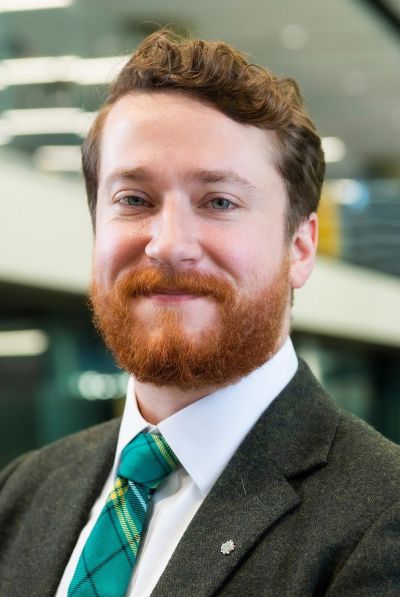
The Alberta School of Business is pleased to welcome Jonathan Craske, an assistant professor in the Department of Accounting and Business Analytics, whose research explores how information and contracting dynamics shape behaviour in capital markets.
Craske joins the school from the University of Southern California, where he completed his PhD after several years working in forensic data analytics at KPMG. His research explores how transparency, regulation, and fast-changing data technologies affect fairness and decision-making in markets. He is especially interested in how today’s quickly evolving information landscape, shaped by new technology, new data, and new policies, changes the way market participants gather and interpret information.
In this Q&A, Craske shares what led him from industry to academia, what excites him about the direction of accounting research, how he approaches teaching, and what he is looking forward to as he settles into life in Edmonton.
You worked in forensic data analytics at KPMG before pursuing a PhD in accounting at USC. What inspired you to make the leap from industry to academia, and how have those experiences shaped your approach to research?
I’ve always been interested in the ways information drives decisions. My time working in forensic data analytics gave me a change to engage with that question from an investigative perspective.
Our practice focused on tracing patterns in data to uncover insights, and I gained a deep appreciation for how access to the right data can resolve complexity and improve decision-making.
From there, it seemed a natural next step to ask how information dynamics play out across markets, and how policy and transparency shape the flow of information more broadly. That’s what drew me to academia and the idea of pursuing doctoral research.
At the same time, my experience in practice still grounds how I approach my research. It taught me to approach research with a healthy skepticism, to appreciate the complexity and frictions of real-world data, and to keep sight of the broader context beyond any single theoretical framework.
Your research focuses on information and contracting dynamics in capital markets – especially around policy, regulation, governance and new open data sources. How would you explain your research to someone outside the field, and what excites you most about this area?
In my research, I study how information gets produced, shared, and used in financial markets, and how that process is influenced by regulation, policy, and incentives. I’m particularly interested in information asymmetry: how differences in the availability, timing, and precision of information across market participants can influence behaviour and outcomes.
It’s fascinating to see how informational frictions can ripple through markets, shaping pricing dynamics, governance, and the broader efficiency of capital allocation. I enjoy connecting these abstract concepts to real-world settings where policy and institutional design make a tangible difference.
What excites me most about this area is how drastically information environments have changed in recent years, and how they continue to evolve with new technologies, policies, and forms of disclosure. The expansion of data availability and analytical capabilities is transforming how information is generated, disseminated, and processed, while policymakers are continually adapting to this increasingly complex environment.
These developments make the study of information and markets incredibly dynamic, raising new questions about how regulation, innovation, and information interact in shaping modern capital markets.
Emerging open and alternative data are a big part of your research interests. How do you see these new data sources changing the world of accounting or investing, and which trends in this space are you most excited to explore?
Emerging trends in open and alternative data have dramatically expanded what we can observe and analyze. Today, researchers, managers, investors, and policymakers have access to far more information than what appears in traditional financial statements and regulatory filings. This shift has created a new environment for how information works in markets, bringing both opportunities and challenges as people adapt to an information landscape filled with abundance and complexity.
For accounting research, it represents a major change. The idea of "accounting information" now includes the wider system through which markets find, gather, and process data to make decisions. I find this broader view of accounting especially compelling because it allows us to explore new questions about transparency, efficiency, and the role of information in society.
Students at USC have praised your ability to make accounting “approachable and exciting.” What is your teaching philosophy, and how do you plan to engage students in your classes at the Alberta School of Business?
My teaching philosophy centers on helping students build confidence in their curiosity and feel comfortable confronting challenging material. Many students are more inquisitive than they realize, and I see it as my role to help them recognize and develop that instinct by creating an environment where curiosity is encouraged and engagement with new ideas feels rewarding.
I see accounting as a foundational literacy for understanding how information shapes decisions and institutions, and I design my courses to help students apply concepts across contexts and connect what they learn to the world around them.
My goal is for them to leave not only with stronger analytical and accounting skills, but with genuine excitement about the new questions this knowledge can inspire.
Now that you’re joining the Alberta School of Business, what are you most looking forward to in your first year here – whether in your research, teaching, or life in Edmonton?
What I’m most looking forward to is the sense of discovery that comes with starting somewhere new. The Alberta School of Business has such an exciting research community, and I can’t wait to collaborate with colleagues whose approaches and interests push my own thinking in new directions. I’m also really looking forward to being back in the classroom. There’s something energizing about working with a bright, motivated group of students and seeing how they engage with the material in their own ways.
Outside of campus, I’m eager to get to know Edmonton, explore the trails in the river valley, take some trips into the Rockies, and experience a city that offers something completely different from anywhere I’ve lived before.
Outside of work, you’re an avid vinyl record collector. What’s one of your favorite albums or artists to listen to on vinyl, and why?
David Bowie has always been my favourite artist. I love how his sound evolves so completely from one album to the next, yet the creativity and energy never fade. There’s a constant sense of experimentation and curiosity in his work; he was always willing to take risks and push his music in new directions. It’s a good reminder to keep an open mind, keep learning, and enjoy where that spirit of exploration can take you.
Subscribe to UAlberta Business
Become part of our community. Get the latest news and event information from the Alberta School of Business in your inbox every month.