Student Spotlight
From the Other Side of Care
What Kyra Mazer brings to OT that can't be taught in a classroom
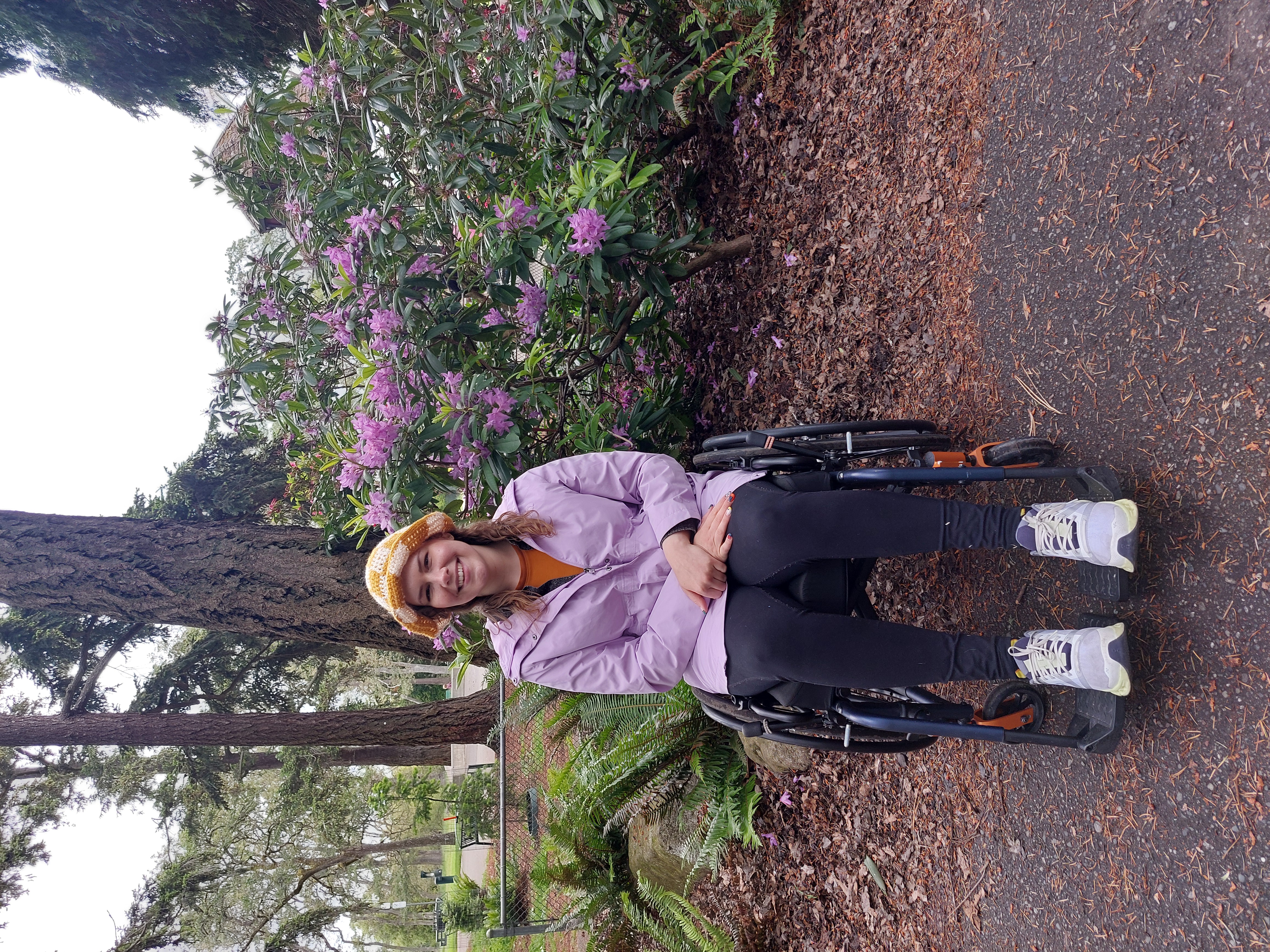
Equity in education affects equity in healthcare. When the people training to become rehabilitation practitioners reflect the full range of human experience — including the experience of disability — the profession becomes more responsive, more imaginative, and more just. Kyra Mazer knows this not as an abstract principle, but as something she has lived on both sides of the clinical relationship.
And then OT came along
Four years ago, Kyra didn't know what an occupational therapist did. Like a lot of people, she didn't think she needed to.
Then her life changed.
After a significant shift in her health status, Kyra transitioned from an able body to a disabled one. She found herself navigating a world that suddenly looked very different — physically, emotionally, and practically. It was in that vulnerable space that she met the occupational therapists who would, as she puts it, restore her confidence and independence.
"When I became disabled, I was at a point where I didn't know how to picture the rest of my life — how I would do the things I normally did," she says. "And then OT came along."
What followed was a collaborative process she hadn't expected: therapists who asked what mattered to her, who worked around her priorities, and who helped her imagine — and then build — a life that felt like her own again.
“It was incredibly exciting to see their creativity in action, and how their patient-centered care helps people thrive and return to the activities they love,” Kyra says. “I knew I wanted to do the same for others.”
Now in her first year of the MScOT program, Kyra’s path hasn't been without its hurdles. As a wheelchair user, she entered the program with some natural trepidations, having faced discrimination at two previous institutions.
"When you come into a new institution, your guard is up," she says plainly. "Sharing parts of yourself means you can access accommodations — but you're always wondering, what does that mean for how this information is used?"
To just feel heard makes me feel seen
What she found at FRM surprised her. From the start, the faculty worked with her to develop an accommodation plan — and the process was collaborative, not imposed.
"I've been so pleased with how well I'm listened to. When I say something, it's deeply considered. Questions are asked to make sure I'm comfortable and we're accessing the right solutions. To just feel heard makes me feel seen. And I think that's so important when I'm studying to represent clients."
I’d rather someone ask me imperfectly
The impact of Kyra's perspective isn't just personal — it's pedagogical. During a unit on wheelchair maintenance, the professor leading the session paused and asked Kyra if she had anything to add.
"I did share a little bit, and that felt so good," she says. "To feel, once again, seen and heard — that my perspectives are important."
She's noticed moments where her point of view gently shifts the conversation among classmates — not to challenge, but to offer what's often missing: the patient's perspective from the inside.
“A lot of my classmates are drawing on people they've worked with or volunteered with," Kyra notes. "When I give my perspective, it's coming from my own personal life, or from my friends who are also wheelchair users. I know you see it this way, but this is also what I've seen—as someone who's been the patient.”
While she acknowledges that navigating these conversations can feel difficult or uncomfortable for many, she welcomes the dialogue.
"I think sometimes people don't know what to say, so they say nothing," she reflects. "But I'd rather someone ask me something imperfectly than not ask at all. I'm not going to be offended. I want to share."
The Gaps She's Already Seeing
On a recent placement in an acute care setting, what struck Kyra most wasn't the clinical complexity — it was the gaps.
"There's so much that patients need that exists outside the hospital walls," she says. "And a lot of people don't know how to access it, or don't have someone to help them navigate."
She speaks from experience. When she was first navigating the healthcare system after her own health changes, strong early support made all the difference — peer mentorship, community organizations, a rehab team that connected her to resources before she left the hospital.
"When I came out, everything didn't still feel brand new. I felt prepared."
She thinks about the patients who don't have that.
"I think about the barriers that I and my community have to deal with. Improvements could be made," she says. "Because a lot of able-bodied people are going to face those same challenges as they age."
Kyra plans to return to Saskatchewan to practise when she graduates. She'll bring with her something that can't be taught in a classroom: the knowledge of what it means to need care, to receive it well, and to understand — from the inside — what's at stake when it falls short.
Equity doesn't happen by accident. It has to be designed — and it has to be practised. Kyra is already doing both.
Your perspective shapes the profession
Equity-focused rehabilitation doesn't happen in a vacuum — it's built from the lived experiences of the people who practice, teach, and champion it. Whether you're a student, a graduate, a faculty member, or a friend of FRM, your perspective matters. Every story adds to a richer, more responsive profession.
Share your story