Clinical Spotlight | Covenant Health
Where learning becomes practice
Why clinical placements matter in rehabilitation medicine
By Erika Nakatsui · October 2026
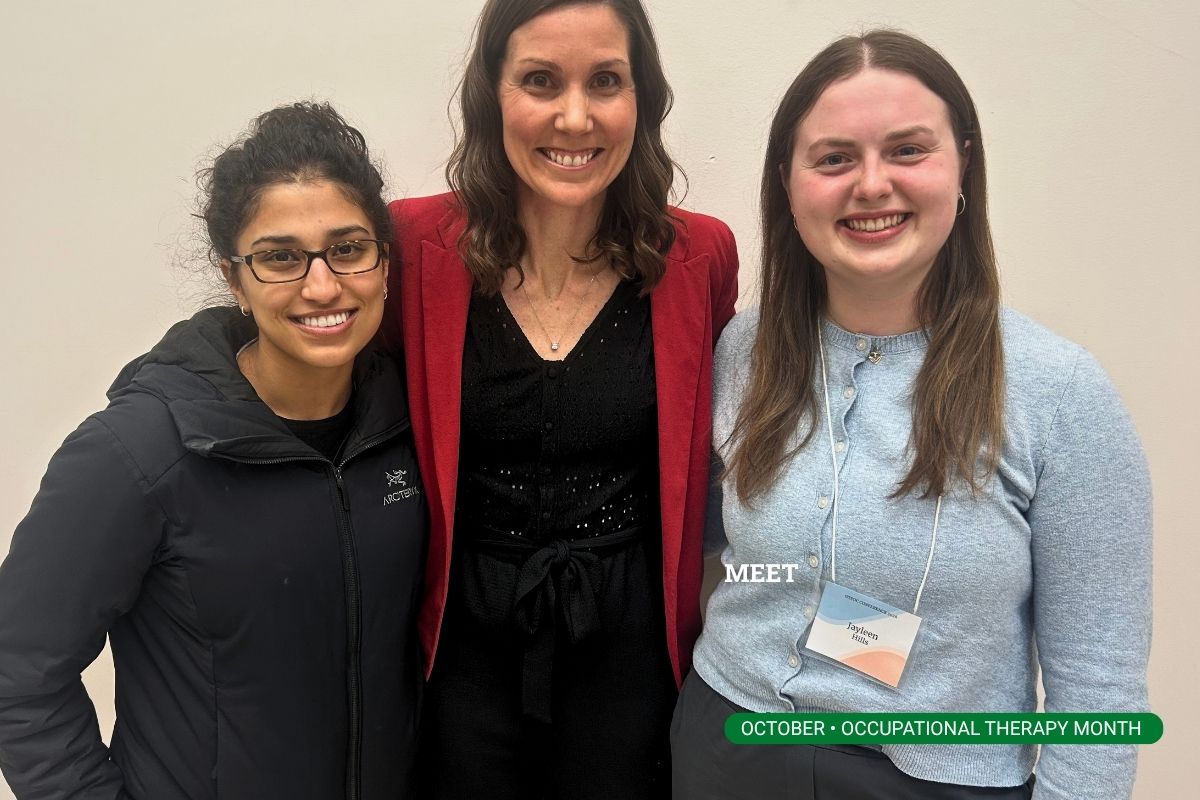
Whitney McKenzie (centre) with OT students Jayleen Hills and Élise Machado
Occupational therapy students spend a lot of time with textbooks, lectures and theory. On placement, they find out what all of it looks like with a real person in front of them.
Clinical placements are central to graduate education in the Faculty of Rehabilitation Medicine. They are where students put their training to work and learn how to build relationships with the people they serve. Three people who shared a recent placement, a clinical educator and two OT students, talked about what they took from the experience.
Guiding the journey
Whitney McKenzie’s career has taken her to a lot of places. She earned an undergraduate degree in psychology at the University of Alberta and a Master of Occupational Therapy in Brisbane, Australia. She has worked in clinical roles at Covenant Health, in tertiary rehab at the Glenrose and in pediatric intensive care at the Stollery Children’s Hospital. For nearly seven years, she has worked in leadership and professional practice.
Today, Whitney is a practice leader with Covenant Health, supporting allied health teams at several long-term care sites. She is also a clinical educator, and some of the moments that shaped her most as a professional have come from that work.
“When I started taking students, I realized I’m never going to be the expert in any field,” she says. “There’s always going to be more to learn, more directions to grow.”
Early on as a preceptor, she felt she had to have the answers, walk students through the evidence and show she was competent. She sees the role differently now. In her view, students learn most from a supervisor who shows them how to ask good questions, build relationships and work through uncertainty.
“I just wonder how we continue to reinforce with preceptors that you don’t need to feel comfortable in any area of practice,” she says. “You just need to support and guide that learning journey.”
Two clinical educators from her own master’s program have stayed with her for 15 years. One worked in pediatric oncology and showed a kind of compassion she had rarely seen. The other worked in brain injury and stroke rehabilitation and stood out for his integrity. He was committed to the evidence and never cut corners, even when the work was hard.
“Without having students in our workforce, we don’t have the opportunity to dig as deep into the evidence,” she says. “Just having students consistently has really brought to the forefront the importance of curiosity in everyday practice.”
“You just need to support and guide that learning journey.”
Whitney McKenzie, practice leader, Covenant Health
Finding her own way to lead
Jayleen Hills is in the final months of her Master of Science in Occupational Therapy. She talks openly about the parts of the program she found hard.
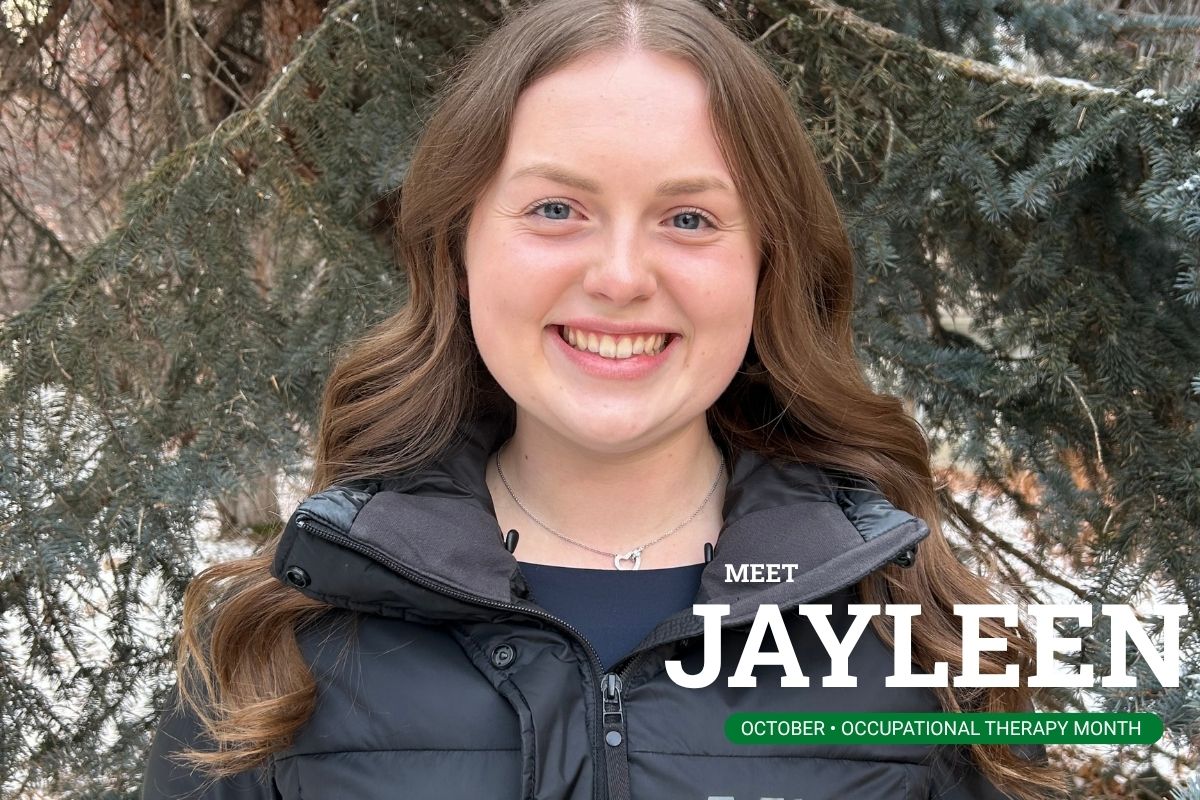
Jayleen Hills, MScOT student
She found OT by chance. While working at a summer biking camp, she was paired one-on-one with a girl who had autism. Over several days, Jayleen figured out how to support her, using visual cues and adjusting her approach to what the girl responded to. At the end of the week, the girl’s father asked whether Jayleen had ever thought about occupational therapy.
She had never heard of it.
Her most recent placement was with Whitney’s professional practice team at Covenant Health. Instead of working directly with clients, Jayleen and her placement partner, Élise, worked on organizational leadership. They visited sites in Edmonton and rural Alberta and researched a project to expand the scope of practice for therapy assistants at Covenant Health’s long-term care sites. They then wrote a summary report and presented it to several groups within the organization.
“There’s not a lot of leadership opportunities for placements,” Jayleen says. “When I saw it, I was like, I want that.”
She started the placement anxious about speaking up in groups, something she had found difficult even in her cohort of 100 students. Early on, she told Whitney about it.
Whitney described members of her own team, capable and respected leaders, who led quietly. They listened more than they talked, and they often followed up after a meeting with a thoughtful email.
“She was like, there’s a time and place to speak up, but you don’t have to force yourself to just talk for the sake of talking,” Jayleen recalls. “And I was like, oh. I don’t think any less of those people. They’re great leaders.”
She counts that conversation among the most important moments of the placement.
She also learned to take initiative. That meant contacting people she didn’t know and asking for their time, knowing a “no” would leave her no worse off.
“Élise was really good at being like, we just have to ask,” Jayleen says. “It didn’t matter that we were students. Whitney said it was fine. And everyone was really kind.”
Along with the report, the two students built an equipment tracking system for a rural long-term care site that didn’t have the time or resources to create one. They also made an instructional video so any staff member could learn to use it.
“I was really proud of that,” Jayleen says. “It felt like something they could use right now.”
Speaking both languages
Élise Machado came to the placement with a different goal. She is completing an OT degree and an MBA at the same time because she wants to connect clinical practice and organizational leadership.
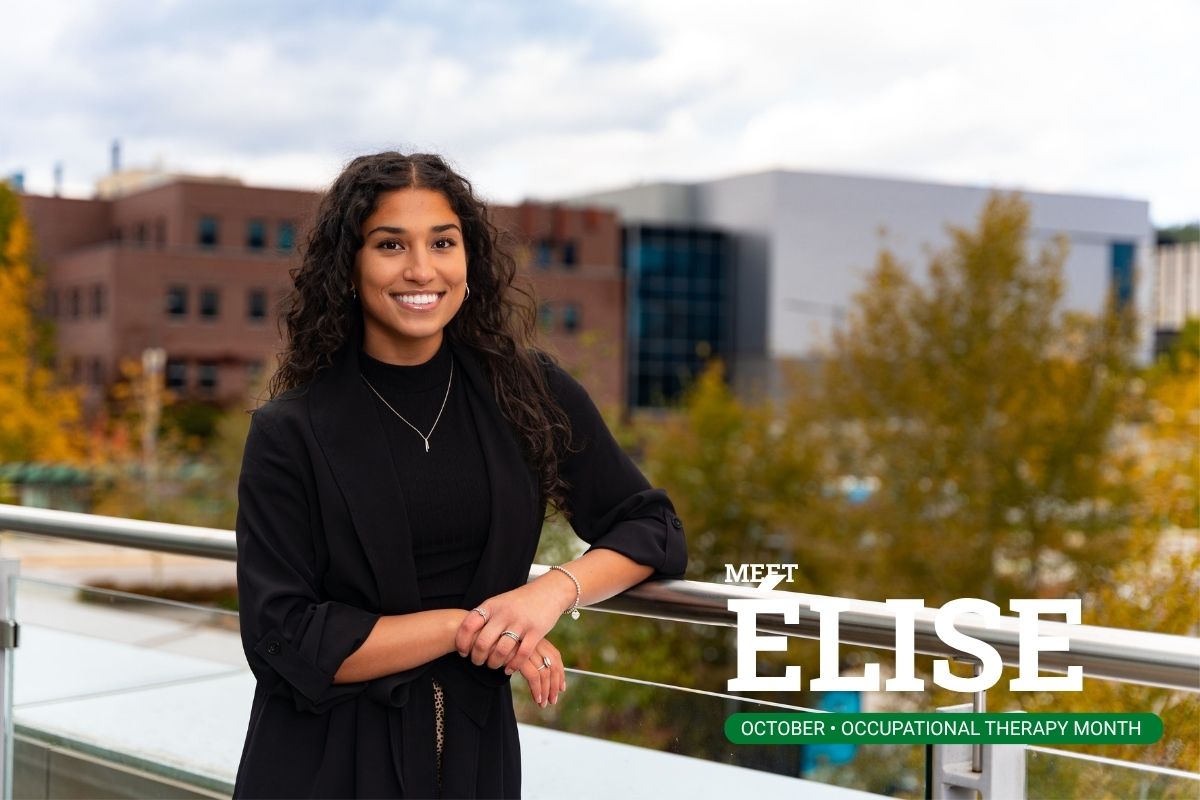
Élise Machado, MScOT and MBA student
Her undergraduate degree in human kinetics introduced her to the science of behaviour change. “I was shocked that there’s a theory behind behaviour change,” she says. “It’s not just, ‘you need to exercise more.’ And I was shocked that this wasn’t part of our elementary school education.”
She chose occupational therapy because it looks at what keeps people from doing the things they want to do, instead of simply telling them what to do.
The placement showed her that clinicians and organizations often don’t understand each other, and that someone needs to be able to work in both worlds.
“There needs to be, whether it’s a group, whether it’s a person, something that can kind of speak both languages, have both perspectives,” she says. “That kind of supports my career direction.”
The placement also challenged some of her assumptions. Élise grew up moving between Calgary, Toronto and Houston and had only ever lived in big cities. When she heard about limited access to health care in rural areas, she admits she wondered why people didn’t just move.
Then she visited Mundare, Alta.
“Getting to go into that rural setting and seeing people who had lived there 80 years, all their kids are nearby, this is their community, this is everything they know,” she says. “I didn’t recognize that that would be important to someone.”
Whitney had told her that people’s stories often teach more than statistics do. In Mundare, Élise saw what she meant.
The hardest part of the work was balancing input from several teams, including professional practice, strategic analytics, project leads and frontline clinicians. Whitney and a colleague, Bryce, told the students plainly that there was no easy answer. They encouraged Élise and Jayleen to trust their own judgment.
“They said, you’ve been in the weeds on this project. You’ve looked at the discrepancies. You can take this feedback, interpret it, and see what’s most appropriate,” Élise recalls. “At the end of the day, this is your project and you know the background you’re coming from.”
The last day
On the final day of the placement, Jayleen and Élise gave two presentations, one to Whitney’s leadership team and one to frontline staff. They adjusted each one as they went.
Whitney watched from the side.
“To see their confidence on those different forums,” she says, “really just resonated with the work that they had done. They presented very differently to each of the groups. They adapted. They engaged. There were so many good questions.”
“They could read their audience and pivot. That just really resonated with me about how strong they were and what great clinicians, and members of society, they would continue to be.”
The students also had a gift for Whitney: a cookbook. Early in the placement, she had mentioned wanting to cook better for her family, and they remembered.
“They said: understanding the why behind what makes people strong in their roles has helped us understand the importance of the relational aspect of occupational therapy,” Whitney recalls.
“I was like, oh. They get the relational part of it.”
Placements teach students how to pay attention to people, listen for what matters to them and keep learning from the people around them. Whitney’s experience shows that preceptors learn the same things from their students. The Faculty of Rehabilitation Medicine has been preparing students this way for 50 years.
Your perspective shapes the profession
Do you have a story about occupational therapy or rehabilitation? Whether you’re a student, graduate, preceptor, faculty member or friend of FRM, we’d like to hear it.