Alumni Spotlight | Hayley Laughlin
High Prairie’s new occupational therapist learned the job in her hometown hospital
Hayley Laughlin, a 2026 MScOT grad, works alongside her 84-year-old grandmother and hopes more new grads will consider rural practice.
By Erika Nakatsui · October 2026
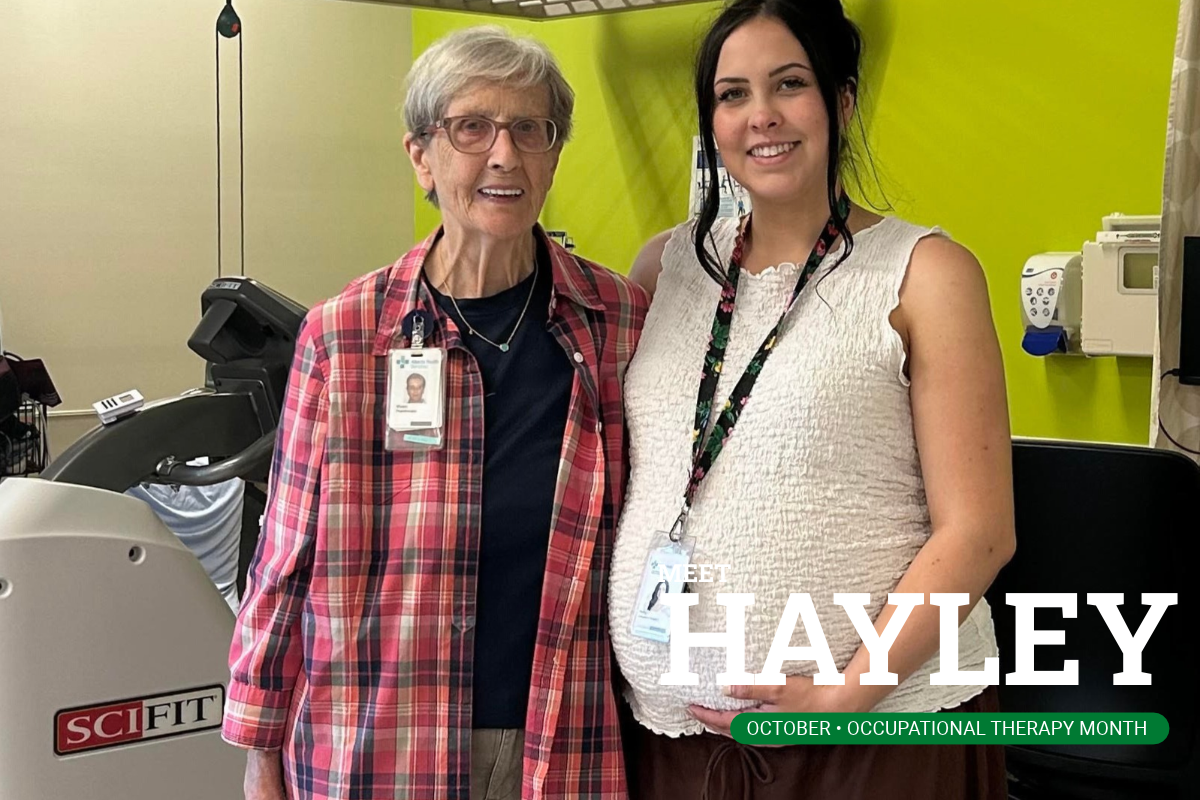
Hayley Laughlin (left) with her grandmother, Vivien, a physiotherapist at the High Prairie hospital
About 10 years ago, Hayley Laughlin did a placement at the hospital in High Prairie, Alta., as a rehab assistant student. Staff were moving into a new building that year. In March 2026 she came back as the hospital’s occupational therapist. She is the only one.
“It’s super full circle for me,” says Laughlin. “It’s been 10 years, I feel like, in the making for me to have this job.”
Laughlin was born and raised in High Prairie. The town hadn’t had a full-time OT in roughly a decade. She started on the hospital’s 30-bed acute care unit, where one week might bring a hip replacement, a stroke, a spinal cord injury and a hand injury. Once she is back from maternity leave, she will also work in long-term care and assisted living, and see outpatients.
“Being rural, you have to know everything and do a little bit of everything,” she says.
A family business
Laughlin is one of three therapists on the hospital’s rehab team. Another is her grandmother, Vivien, an 84-year-old part-time physiotherapist who has worked with Alberta Health Services for about 50 years. Laughlin helps her with the hospital’s computer systems. The third is Lorna Boisson, a part-time physiotherapist who has worked in High Prairie for almost 30 years. Both have been fiercely dedicated to serving High Prairie and the surrounding communities, and Laughlin draws on their knowledge of rural health care.
“It’s kind of like a family business here,” Laughlin says.
As a kid, she visited her grandmother at work, and in high school she volunteered in the rehab department. Her grandfather Robin Laughlin was a doctor at the hospital and served the community for almost 50 years before retiring. The hospital even sits on a road named for him: Laughlin Way. Her late kokum, Lily Anderson, was a care aide in long-term care. “Both of my grandmothers really inspired me to do this kind of work,” she says.
Choosing rural practice
She decided on rural practice while training as a rehab assistant at the Glenrose Rehabilitation Hospital in Edmonton. One of her patients there was from High Prairie. He was transferred home around the time she started a placement in town, so she saw both ends of his recovery.
“I knew I needed to be able to give this person the same care that they get in the city,” she says. “There’s just not enough people to do it.”
The shortage affects her family too. When we spoke with Laughlin in May, she was seven months pregnant with her second child. Babies can’t be delivered in High Prairie, and the nearest option is about an hour and 45 minutes away, so she planned to give birth in Edmonton, where her sister lives. Other families often have to book a hotel for a week and wait.
“I knew I needed to be able to give this person the same care that they get in the city.”
Hayley Laughlin
Learning with home in mind
In class, Laughlin often had to work out how a lesson would apply at home. Patients in High Prairie can’t practise riding the bus because there isn’t one. Some streets have no sidewalks for wheelchair training. Like many rural hospitals, High Prairie’s isn’t as well equipped as urban facilities.
“I always had to think, how would this work where I’m from,” she says.
Two of her four placements were in northern Alberta. One was in Valley View, where her preceptor was the community’s only OT, and the other was with the local school district. She had her first child partway through the program, so she finished her coursework first and then did three placements in a row.
She was skeptical of telerehabilitation when she studied it, mostly because of technology problems. The hospital now runs virtual physio sessions with an on-site therapy assistant, and she says it’s working.
Every day is different
In April, Laughlin passed the National Occupational Therapy Certification Exam while working full time, raising a toddler and seven months pregnant. She wants other new grads to look at jobs like hers.
“It’s so much fun because it’s so diverse,” she says. “Every day is different. You never know what you’re going to walk into.”
Your perspective shapes the profession
Do you have a story about occupational therapy or rehabilitation? Whether you’re a student, graduate, preceptor, faculty member or friend of FRM, we’d like to hear it.