Justine Beghin, Class of '25
18 November 2025

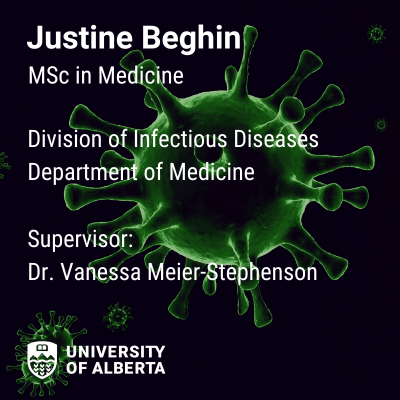
Targeting a Shape-Shifting Virus: Justine Beghin’s Investigation into Influenza Research
Influenza is a virus known for its ability to adapt, evolve, and evade, making it a persistent global health challenge. For Justine Beghin, a 2025 MSc graduate from the Department of Medicine at the University of Alberta, that challenge became the focus of her graduate research and a defining chapter of her scientific journey.
Born and raised in Edmonton, Justine completed her master’s degree under the supervision of Dr. Vanessa Meier-Stephenson. Her thesis, Probing Potential Therapeutic Targets of Influenza’s Viral Polymerase Using an Aptameric Approach, tackled one of the virus’s most essential components: its viral polymerase, the molecular machinery influenza uses to replicate and survive.
Searching for New Ways to Stop the Virus
Justine’s research used an advanced molecular technique called Systematic Evolution of Ligands by Exponential Enrichment (SELEX). Through this process, she searched for novel single-stranded DNA sequences, known as aptamers, that could bind to the three subunits of the influenza polymerase (PB1, PB2, and PA).
These DNA “hits” were then sequenced and tested to determine whether they could disrupt or shut down the polymerase’s function. The ultimate goal was twofold: to identify potential new influenza polymerase inhibitors, and to design a SELEX platform that could one day be adapted to search for inhibitors targeting other viruses as well.
Resilience at the Bench
Like much of experimental science, Justine’s work demanded patience and persistence. Experiments didn’t always succeed on the first, or even the third, attempt. What mattered most, she learned, was careful documentation, thoughtful troubleshooting, and the willingness to try again.
Equally important was collaboration. “Research is not a solo effort,” Justine reflects. Asking questions, communicating with colleagues, and drawing on the expertise of others often provided critical insight, especially when results didn’t match expectations.
Sharing Discoveries and Earning Recognition
Justine presented her work at several research events, including a poster presentation at the SPP-ARC Ignites Innovation Retreat in Banff and an oral presentation at Infectious Diseases Research Day 2025 in Edmonton. Her research excellence was recognized with multiple awards and scholarships, including an Honourable Mention Poster Presentation Award at the SPP-ARC Retreat, a NSERC/CIHR Canadian Graduate Scholarship, and funding from the Li Ka Shing Institute of Virology and the Faculty of Medicine & Dentistry.
Inspired by Discovery and Mentorship
What inspires Justine most is science itself: the constant process of learning, questioning, and discovery. During her master’s training, her supervisor, Dr. Meier-Stephenson, played a pivotal role in shaping her development as both a scientist and a future physician. “She is an amazing physician and researcher who I aspire to be like,” Justine says, crediting her mentorship with unforgettable experiences and lasting lessons.
Today, Justine is continuing her journey in health care as a medical student at the University of Calgary’s Cumming School of Medicine. Her graduate research laid a strong foundation in critical thinking, resilience, and scientific curiosity, skills she now carries forward into her medical training.
Outside the lab and classroom, Justine finds balance through reading and creating art, especially scratch art. As she moves ahead in her medical career, she remains motivated by the same curiosity that first drew her to science, and by the possibility that today’s experiments may become tomorrow’s breakthroughs.