Lamia Khan, Class of '26
12 June 2026

Searching for Answers to a Devastating Disease
When Lamia Khan began her PhD journey, she set out to better understand systemic sclerosis (SSc), a rare and serious autoimmune disease that causes excessive scarring of the skin and internal organs. The disease can lead to significant disability and reduced life expectancy, and effective treatment options remain limited.
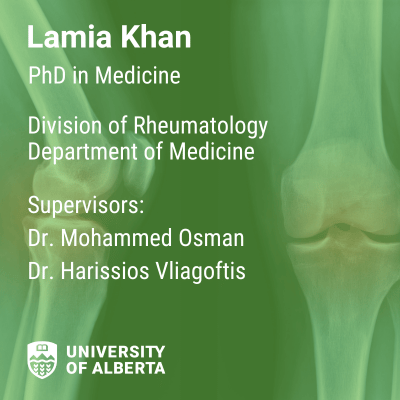
Last week, Khan graduated with a PhD in Medicine from the Division of Rheumatology. Working under the supervision of Dr. Mohammed Osman and Dr. Harissios Vliagoftis, she spent years investigating the cellular and molecular changes that drive the disease.
Her research may help pave the way for new therapies that target the root causes of fibrosis.
A Closer Look at the Cells Behind Scarring
Fibrosis, the excessive buildup of scar tissue, is one of the hallmarks of systemic sclerosis. Khan's research focused on fibroblasts, the cells responsible for producing that scar tissue.
She discovered that fibroblasts in systemic sclerosis develop unique survival mechanisms that allow them to persist and continue driving disease progression. Her work also revealed that these cells contain unusually high levels of a sugar molecule called polysialic acid.
Most importantly, she found that blocking polysialic acid reduced fibrotic activity, suggesting that it plays a critical role in the scarring process.
These findings identify polysialic acid as a promising therapeutic target and could ultimately lead to new treatment approaches for people living with systemic sclerosis.
Persistence, Curiosity, and Discovery
Throughout her doctoral studies, Khan became known for her determination and productivity. She presented her work at numerous national conferences and scientific meetings, delivering oral presentations across Canada on topics ranging from fibrosis and metabolic stress to glycomics and autoimmune disease.
Her research earned significant recognition, including the Ballermann Translational Research Fellowship Award, a Canadian Rheumatology Association Travel Bursary, the WCHRI Graduate Studentship Award, and the Canadian Arthritis Research Conference Best Research Presentation Award.
She also contributed to multiple peer-reviewed publications, helping advance scientific understanding of systemic sclerosis and related disease mechanisms.
Despite these accomplishments, Khan says one lesson stands above all others.
"The most valuable lesson I learned during my academic journey is that persistence, curiosity, and a willingness to keep learning are often the keys to overcoming challenges and achieving meaningful success."
Inspired by Patients
For Khan, the motivation behind her research has always been clear.
She draws inspiration from people living with systemic sclerosis and the challenges they face every day. Their resilience and determination fueled her commitment to finding answers that could improve treatments and quality of life.
That connection to patients helped sustain her through the inevitable setbacks and uncertainties that come with scientific research.
Her advice to future graduate students reflects that experience: stay curious, be resilient, and remember that growth often comes from the challenges that seem most difficult at the time.
Finding Balance in the Garden
Outside the laboratory, Khan found a different way to nurture growth.
Her favourite distraction during graduate school was gardening, an activity that allowed her to step away from experiments, recharge, and find balance amid the demands of research.
Now, as she celebrates the completion of her PhD, Khan leaves behind a body of work that has expanded our understanding of systemic sclerosis and opened new avenues for future investigation.
For the patients who inspired her work, that may prove to be the most meaningful achievement of all.