Thomas Simmen

Thomas Simmen
Ph.D., University of Lausanne
Professor
Office: 5-65A Medical Sciences BuildingLaboratory: 5-65 Medical Sciences Building
thomas.simmen@ualberta.ca
Research
Function of Endoplasmic Reticulum (ER)-Mitochondria Contact Sites in Rare Children's Epileptic Syndromes and Neuroinflammation
Current biomedical research aims to understand how we can pharmacologically halt the progression of a variety of genetic and chronic diseases that are associated with altered cell biological architecture. Frequently, it is thought that a major consequence for such changes is the alteration of cellular metabolism that would compromise the proper functioning and survival of cells.
Our laboratory works to understand how such changes occur and how we can manipulate them, with the goal to apply our findings for rare children's epileptic syndromes and neuroinflammation. We have published that altered interaction between the endoplasmic reticulum (ER) and mitochondria triggers epilepsy and brain development issues in children (Chen et al., 2025), but also activates neuroinflammation (Samtleben et al., 2022) that we can pharmacologically target (Maguire et al., 2025). On these intracellular membrane contact sites, the ER and mitochondria exchange Ca2+ ions. This ion flux controls the progression of the Krebs cycle inside mitochondria and can trigger the release of pro-apoptotic proteins, as well as reactive oxygen species (ROS) from mitochondria. Therefore, the extent by which the ER and mitochondria interact with each other determines oxidative stress, cellular energy production and cellular death.
In further publications from the lab (see list), we have shown that when contacts between the ER and mitochondria are not formed properly, imbalances of cellular metabolism and abnormal cellular lifespan result. These are typically associated with increased oxidative stress. We have detected such changes in specimens from human patients that suffer from cancer and multiple sclerosis (MS), but also from mutations in proteins that control the ER-mitochondria interface. In ongoing research, we now characterize further mechanisms associated with defects of ER-mitochondria contacts and how they malfunction in disease.
Candidates for undergraduate research (Cell 398, 498, 499), for summer studentships, for graduate studies or for postdoctoral fellowships are invited to contact the Principal Investigator at thomas.simmen@ualberta.ca.
 |
|
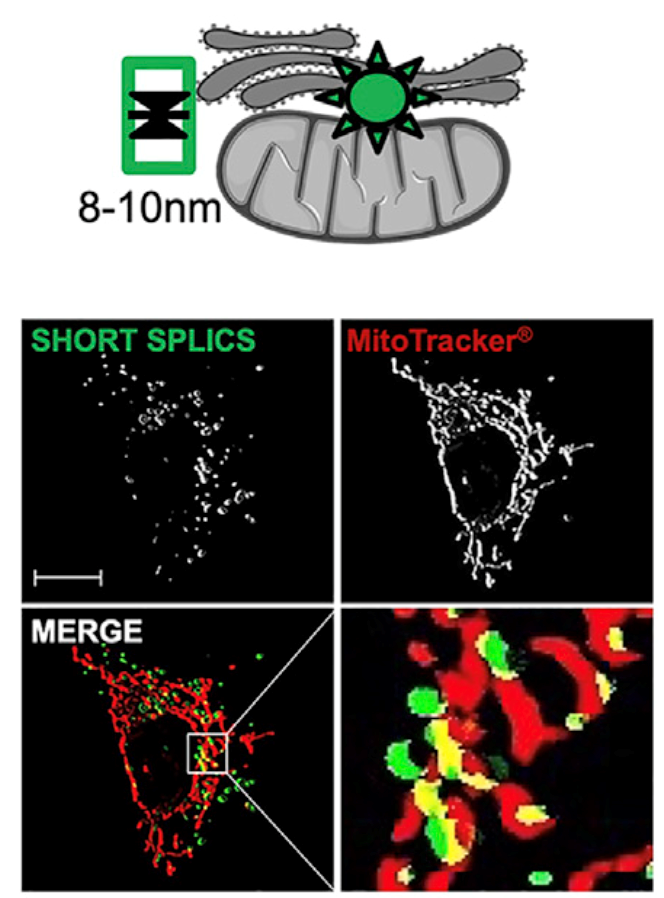
Measuring the extent of ER-Mitochondria contact formation using the SPLICS fluorescent probe |
Selected Publications
- Chen J, Yap MC, Bassot A, Pascual DM, Makio T, Zimmermann J, Mast H, Bhat R, Fleury SG, Fan Y, Buzatto AZ, Moore J, Ballanyi K, Li L, Overduin M, Lemieux MJ, Lemieux H, Mancini GMS, Morgan B, Marcogliese PC, Simmen T. The ER thioredoxin-related transmembrane protein TMX2 controls redox-mediated tethering of ER-mitochondria contacts. Cell Rep. 2025 Nov 25;44(11):116486. doi: 10.1016/j.celrep.2025.116486. Epub 2025 Oct 31.PMID: 41175374
- Maguire AD, Lamothe SM, Yousuf MS, Goss K, Rao J, Tenorio G, Kaulagari SR, Hazlehurst L, Plemel JR, Taylor AMW, Kurata HT, Simmen T, Kerr BJ. Inhibition of Endoplasmic Reticulum Oxidoreductin 1 Modulates Neuronal Excitability and Nociceptive Sensitivity in Mice. Anesthesiology. 2025 Jul 1;143(1):168-190. doi: 10.1097/ALN.0000000000005453. Epub 2025 Mar 19.PMID: 40106735
- Makio, T., and Simmen, T. (2024) Not so rare: diseases based on mutant proteins controlling mitochondria-endoplamic reticulum (MERC) tethering. Contact (Thousand Oaks) 2024 Jul 25;7:25152564241261228. doi: 10.1177/25152564241261228. eCollection 2024 Jan-Dec.
- Bassot, A., Chen, J., Takahashi-Yamashiro, K., Yap, M.C., Gibhardt, C.S., Le, G.N.T., Hario, S., Nasu, Y., Moore, J., Gutierrez, T., Mina, L., Mast, H., Moses, A., Bhat, R., Ballanyi, K., Lemieux, H., Sitia, R., Zito, E., Bogeski, I., Campbell, R. and Simmen T. (2023) The endoplasmic reticulum (ER) kinase PERK interacts with the oxidoreductase ERO1 to metabolically adapt mitochondria. Cell Reports. 42(1) 111899.
- Samtleben S, Mina L, Yap MC, Branton WG, Yousuf MS, Tenorio G, Ballanyi K, Giuliani F, Kerr BJ, Power C, Simmen T. Astrocytes show increased levels of Ero1α in multiple sclerosis and its experimental autoimmune encephalomyelitis animal model. Eur J Neurosci. 2022 Oct;56(8):5177-5190. doi: 10.1111/ejn.15817. Epub 2022 Sep 21. PMID: 36083288
- Herrera-Cruz MS, Yap MC, Tahbaz N, Phillips K, Thomas L, Thomas G,and Simmen T. Rab32 uses its effector reticulon 3L to trigger autophagic degradation of mitochondria-associated membrane (MAM) proteins. Biol Direct. 2021 Nov 7;16(1):22.
- Yousuf MS, Samtleben S, Lamothe SM, Friedman TN, Catuneanu A, Thorburn K, Desai M, Tenorio G, Schenk GJ, Ballanyi K, Kurata HT, Simmen T, and Kerr BJ. (2020) Endoplasmic reticulum stress in the dorsal root ganglia regulates large-conductance potassium channels and contributes to pain in a model of multiple sclerosis. FASEB J. 2020 Jul 17. doi: 10.1096/fj.202001163R.
- Gutiérrez, T., Qi, H., Yap, M.C., Tahbaz, N., Milburn, L.A., Lucchinetti, E., Lou, P.H., Zaugg, M., LaPointe, P.G., Mercier, P., Overduin, M., Bischof, H., Burgstaller, S., Malli, R., Ballanyi, K., Shuai, J.,and Simmen T. (2020) The ER chaperone calnexin controls mitochondrial positioning and respiration. Sci Signal. 2020 Jun 30;13(638):eaax6660. doi: 10.1126/scisignal.aax6660.
- Scorrano L, De Matteis MA, Emr S, Giordano F, Hajnóczky G, Kornmann B, Lackner LL, Levine TP, Pellegrini L, Reinisch K, Rizzuto R, Simmen T, Stenmark H, Ungermann C, and Schuldiner M. (2019) Coming together to define membrane contact sites. Nat Commun. 2019 Mar 20;10(1):1287. doi: 10.1038/s41467-019-09253-3.
- Yoboue, E.D., Sitia, R., and Simmen, T. (2018) Redox crosstalk at mitochondria-associated membranes (MAMs) uses toxic waste to deliver messages. Cell Death and Disease. 28; 9 (3): 331.
- Haile, Y., Deng, X., Ortiz-Sandoval, C., Tahbaz, N., Janowicz, A., Lu, J. Q., Kerr, B. J., Gutowski, N. J., Holley, J. E., Eggleton, P., Giuliani, F.,Simmen, T. (2017) Rab32 connects ER stress to mitochondrial defects in multiple sclerosis. Journal of Neuroinflammation. 23;14(1):19.
Laboratory Members
Graduate Students
Yeonghwa Cho
Daniel Hong
Postdoctoral Fellow
Saba Qureshi
Research Associate
Tadashi Makio
Technician
Megan Yap